
Contents
- 🎵 Origins & History
- ⚙️ How It Works
- 📊 Key Facts & Numbers
- 👥 Key People & Organizations
- 🌍 Cultural Impact & Influence
- ⚡ Current State & Latest Developments
- 🤔 Controversies & Debates
- 🔮 Future Outlook & Predictions
- 💡 Practical Applications
- 📚 Related Topics & Deeper Reading
- Frequently Asked Questions
- References
- Related Topics
Overview
The genesis of the Atlantic Wall can be traced to the escalating threat of an Allied invasion following the fall of France in 1940. Initially, German defenses were piecemeal, but by March 1942, Adolf Hitler issued Führer Directive No. 40, mandating the creation of a comprehensive defensive line. The objective was to create an impenetrable barrier against any seaborne assault, leveraging natural coastal features and overwhelming concrete and steel. Construction began in earnest in late 1942, heavily relying on forced labor and resources requisitioned from occupied territories, particularly France. The sheer scale of the project, overseen by the German Army and supported by the Kriegsmarine and Luftwaffe, was unprecedented, aiming to project an image of invincibility, though its strategic effectiveness was debated even within the German high command.
⚙️ How It Works
The Atlantic Wall was not a single, continuous structure but a series of interconnected defensive sectors, each tailored to the local terrain and strategic importance. Key components included heavily fortified gun emplacements (Regelbauten) designed to house artillery pieces ranging from anti-tank guns to heavy naval guns, often disguised to blend with the landscape. Extensive networks of bunkers provided protection for troops, ammunition, and command centers, linked by underground tunnels. Minefields, anti-tank ditches, and beach obstacles like 'Rommel's Asparagus' (long steel poles) were deployed to impede enemy landings. The system was designed to channel attackers into pre-sighted kill zones where artillery and machine guns could inflict maximum casualties, with coastal artillery batteries providing long-range fire support.
📊 Key Facts & Numbers
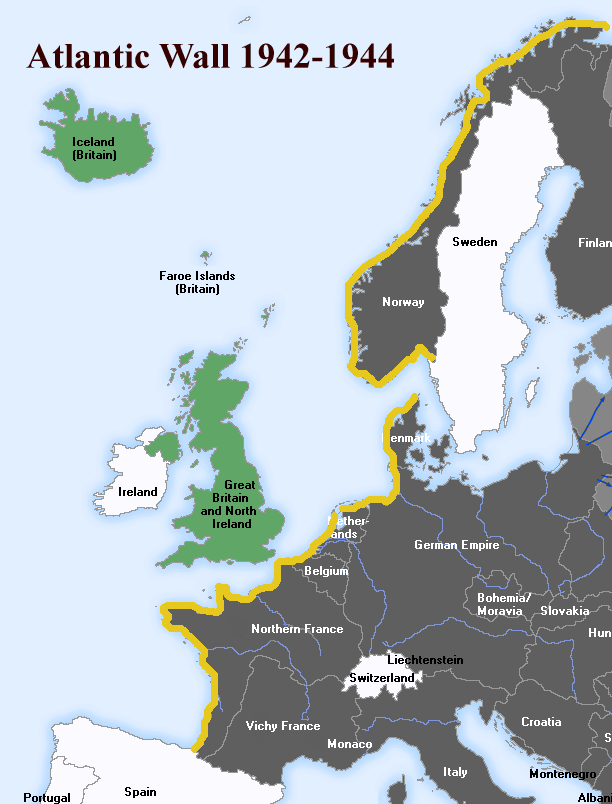
Stretching approximately 2,670 miles (4,300 km) from Norway to the Spanish border, the Atlantic Wall comprised over 15,000 individual fortifications. By D-Day on June 6, 1944, an estimated 300,000 German troops were stationed along its length, though many were second-rate units or auxiliary personnel. The construction consumed vast quantities of concrete, with estimates suggesting over 20 million cubic meters were used. Approximately 500,000 French workers were conscripted into building the wall, contributing to over half of the total construction effort. Despite its immense scale, only about 10% of the wall was heavily fortified, with significant gaps and weaker defenses in less strategically critical areas, a fact that Allied intelligence meticulously documented.
👥 Key People & Organizations
The concept and implementation of the Atlantic Wall were driven by Adolf Hitler, who issued the foundational Führer Directive No. 40. Operational command fell largely to the German Army's Inspectorate for Coastal Defenses, with key figures like Field Marshal Gerd von Rundstedt serving as Commander-in-Chief West. Field Marshal Erwin Rommel was later appointed to inspect and improve defenses, famously advocating for more mobile reserves and forward deployment of tanks. The Kriegsmarine managed its own coastal defense zones, while the Luftwaffe provided air support and ground troops. Allied strategic planning was heavily influenced by intelligence gathered on the wall's strength and disposition, with figures like Dwight D. Eisenhower making critical decisions based on this information.
🌍 Cultural Impact & Influence
The Atlantic Wall became a potent symbol in Nazi propaganda, frequently depicted as an impenetrable shield designed to protect the 'Fortress Europe' from Allied aggression. Its perceived invincibility was a key element in maintaining morale within Germany and intimidating potential enemies. However, its actual military effectiveness was far less than advertised. During the D-Day landings in June 1944, Allied forces successfully breached the wall at multiple points, demonstrating that its construction had not kept pace with Allied offensive capabilities and that its static nature was a significant vulnerability. Post-war, remnants of the Atlantic Wall have become historical sites and tourist attractions, serving as stark reminders of the conflict and the immense human cost of war.
⚡ Current State & Latest Developments
Today, significant portions of the Atlantic Wall remain standing, particularly along the coasts of Normandy, Brittany, and the Netherlands. Many former bunkers and gun emplacements have been preserved, repurposed, or transformed into museums and memorials. For example, the Merville Battery in Normandy is a well-preserved example of a German artillery battery. Coastal fortifications in places like Boulogne-sur-Mer and Dunkirk also draw visitors. While no longer an active military defense, these structures serve as tangible links to World War II history, attracting historians, tourists, and those seeking to understand the scale of the conflict. Ongoing preservation efforts by local authorities and historical societies ensure these sites remain accessible.
🤔 Controversies & Debates
The primary controversy surrounding the Atlantic Wall lies in its ultimate military failure versus its immense cost in resources and human lives. Critics argue that the vast sums and labor expended could have been better utilized elsewhere, particularly on the Eastern Front. The reliance on forced labor also raises significant ethical questions about the exploitation of occupied populations. Furthermore, the effectiveness of the wall's defenses on D-Day is debated; while it failed to prevent the landings, it did inflict considerable casualties on the Allied forces. The propaganda surrounding its invincibility also stands in stark contrast to its actual performance, highlighting the disconnect between Nazi rhetoric and reality.
🔮 Future Outlook & Predictions
The future of the Atlantic Wall's remnants is largely tied to preservation and historical interpretation. Efforts will likely continue to maintain and restore key sites, potentially transforming more structures into educational centers or tourist attractions. There's a growing interest in using these sites to teach about military history, engineering, and the human impact of war. However, the sheer scale of the wall means that many sections will inevitably be lost to coastal erosion, development, or natural decay. The challenge lies in balancing preservation with the practicalities of coastal management and economic development in the regions where the wall stands.
💡 Practical Applications
The most significant practical application of the Atlantic Wall today is as a historical and educational resource. Numerous museums and memorial sites, such as the Atlantic Wall Museum in Hoek van Holland, Netherlands, and the Normandy Victory Museum, utilize former fortifications to educate the public about World War II. These sites offer insights into military engineering, the daily lives of soldiers, and the strategic context of the war. Additionally, some former bunkers have been repurposed for civilian use, such as storage facilities or even unique accommodations, though these are rare. The primary 'application' remains its role in understanding the past and commemorating those who fought and died.
Key Facts
- Year
- 1942-1944
- Origin
- Nazi Germany
- Category
- history
- Type
- concept
Frequently Asked Questions
What was the primary purpose of the Atlantic Wall?
The primary purpose of the Atlantic Wall was to defend Nazi-occupied Europe against an anticipated Allied invasion from the United Kingdom during World War II. It was conceived as an impenetrable line of coastal fortifications designed to repel any seaborne assault and prevent the Allies from establishing a foothold on the continent. The system included thousands of concrete emplacements, bunkers, minefields, and artillery batteries intended to inflict maximum casualties on any invading force and deter an attack altogether.
How long was the Atlantic Wall and what areas did it cover?
The Atlantic Wall stretched approximately 2,670 miles (4,300 km) along the coast of Nazi-occupied Europe. It extended from the Arctic Circle in northern Norway, down through Denmark, the Netherlands, Belgium, and along the entire western coast of France, reaching to the border with Spain. This vast length meant that defenses were not uniform; heavily fortified sectors were concentrated in strategically critical areas like the Pas-de-Calais and Normandy, while other regions had significantly weaker defenses.
Was the Atlantic Wall effective in preventing the Allied invasion?
No, the Atlantic Wall was ultimately ineffective in preventing the Allied invasion. While it did inflict casualties on the Allied forces during the D-Day landings on June 6, 1944, the invasion forces successfully bypassed or overwhelmed key sections of the defenses. The wall's static nature, combined with Allied air superiority, deception tactics, and precise intelligence on its weaknesses, allowed the Allies to establish a crucial beachhead in Normandy. The wall's failure marked a turning point in the war, paving the way for the liberation of Western Europe.
Who built the Atlantic Wall and what resources were used?
The Atlantic Wall was built by Nazi Germany, primarily using hundreds of thousands of laborers, many of whom were conscripted civilians from occupied territories, especially France. Over 20 million cubic meters of concrete were used in its construction, along with vast quantities of steel and other materials. The project was a massive undertaking that diverted significant resources and manpower from other fronts, reflecting the high priority Hitler placed on defending against an Allied invasion.
What remains of the Atlantic Wall today?
Significant remnants of the Atlantic Wall still exist today, serving as historical sites and memorials. Many bunkers, gun emplacements, and sections of the fortifications can be found along the coasts of France, Belgium, the Netherlands, and Norway. These structures have often been preserved, converted into museums (like the Atlantic Wall Museum in Hoek van Holland), or incorporated into coastal defenses and civilian infrastructure. They stand as tangible reminders of World War II and the immense scale of military engineering during the conflict.
How did the Atlantic Wall compare to other defensive lines like the Maginot Line?
The Atlantic Wall differed significantly from the Maginot Line, which was a pre-war French defensive system primarily focused on land borders. The Maginot Line was a static, heavily fortified line of bunkers and artillery designed to repel a frontal assault. The Atlantic Wall, while also static in many respects, was a much more extensive coastal defense system designed to counter seaborne invasions. Both systems ultimately proved vulnerable to new military strategies and technologies; the Maginot Line was bypassed by German forces in 1940, and the Atlantic Wall was breached by the Allies in 1944, highlighting the limitations of purely static defenses against adaptable and determined adversaries.
What was the role of propaganda in relation to the Atlantic Wall?
Propaganda played a crucial role in the narrative surrounding the Atlantic Wall. Nazi Germany heavily promoted it as an impenetrable fortress, an invincible shield protecting 'Fortress Europe.' This was intended to boost morale within Germany, intimidate potential enemies, and project an image of Nazi strength and determination. The reality of the wall's construction, including its gaps and reliance on forced labor, was often downplayed or ignored in official portrayals. The exaggerated claims of its invincibility made its eventual breach on D-Day a significant propaganda defeat for the regime.