
Contents
- 🎵 Origins & History
- ⚙️ How It Works
- 📊 Key Facts & Numbers
- 👥 Key People & Organizations
- 🌍 Cultural Impact & Influence
- ⚡ Current State & Latest Developments
- 🤔 Controversies & Debates
- 🔮 Future Outlook & Predictions
- 💡 Practical Applications
- 📚 Related Topics & Deeper Reading
- Frequently Asked Questions
- References
- Related Topics
Overview
The genesis of cardiac ultrasound traces back to the mid-20th century, building upon the foundational principles of sonar technology developed during World War II. Early pioneers like Karl Dussik in 1942 and Douglas Howry in the 1950s explored the use of ultrasound for medical diagnostics, initially focusing on the brain and abdomen. The critical leap for cardiac imaging occurred in the late 1950s and early 1960s, with researchers like Ingegerd Edler and Hellmuth Hertz in Lund, Sweden, demonstrating the feasibility of using a two-dimensional echocardiographic scanner in 1953, and later developing the first clinical applications. By the 1970s, advancements in transducer technology and imaging processing, notably by companies like Philips and General Electric, led to the development of real-time, M-mode, and Doppler echocardiography, transforming it from a static imaging technique into a dynamic window into the beating heart. The establishment of the American Society of Echocardiography in 1975 further solidified its place in clinical practice and research.
⚙️ How It Works
Cardiac ultrasound operates on the principle of piezoelectricity, where specialized crystals within a transducer emit high-frequency sound waves (typically 1-10 MHz) that travel into the body. When these sound waves encounter different tissues and structures within the heart—such as the muscular walls, valves, or blood—they reflect back as echoes. The transducer then receives these returning echoes, and a sophisticated computer system processes the time-of-flight and intensity of these signals to construct detailed images. Doppler ultrasound, a crucial component, measures the frequency shift of returning sound waves reflected by moving blood cells, allowing visualization of blood flow direction and velocity. This enables assessment of valve function, detection of shunts, and estimation of pressures within the heart chambers. The entire process is non-ionizing, making it a safe imaging modality for repeated use, even in sensitive populations like pregnant women and children.
📊 Key Facts & Numbers
Globally, over 10 million echocardiograms are performed annually, with the market size for echocardiography devices projected to reach approximately $4.5 billion by 2027. In the United States alone, Medicare reimbursed over $1.5 billion for echocardiography procedures in 2022. A standard transthoracic echocardiogram (TTE) typically takes 30-60 minutes to complete. Transesophageal echocardiography (TEE), which involves a probe inserted down the esophagus, offers higher-resolution images and is performed in about 15-20% of cases, often during cardiac surgery or for specific diagnostic challenges. The diagnostic yield of echocardiography is remarkably high, with studies showing it correctly identifies significant cardiac pathology in over 90% of patients with known heart disease. The cost of a single TTE procedure can range from $200 to $1,000, depending on the facility and geographic location.
👥 Key People & Organizations
Key figures instrumental in the development and popularization of cardiac ultrasound include Ingegerd Edler and Hellmuth Hertz, who pioneered early clinical applications in the 1950s and 60s. Reynold Weill and William Perry Edwards were instrumental in developing Doppler echocardiography techniques in the 1960s. Major manufacturers like Philips, General Electric, and Siemens Healthineers have continuously driven innovation in transducer technology and imaging software. Professional organizations such as the American Society of Echocardiography (ASE) and the European Association of Cardiovascular Imaging (EACVI) play critical roles in setting standards, promoting research, and educating practitioners worldwide. Leading research institutions like the Mayo Clinic and Cleveland Clinic are at the forefront of developing novel echocardiographic applications.
🌍 Cultural Impact & Influence
Cardiac ultrasound has fundamentally altered the landscape of cardiovascular medicine, moving diagnoses from speculative to precise and from invasive to non-invasive. It has democratized cardiac assessment, making sophisticated heart imaging accessible in most hospitals and even in some outpatient settings. The visual and dynamic nature of echocardiograms has also influenced medical education, providing powerful teaching tools for understanding cardiac anatomy and physiology. Its widespread use has contributed to earlier detection of diseases like hypertrophic cardiomyopathy and dilated cardiomyopathy, leading to improved patient outcomes. The iconic imagery of a beating heart on an ultrasound screen has also permeated popular culture, often symbolizing life, health, and medical progress in media portrayals.
⚡ Current State & Latest Developments
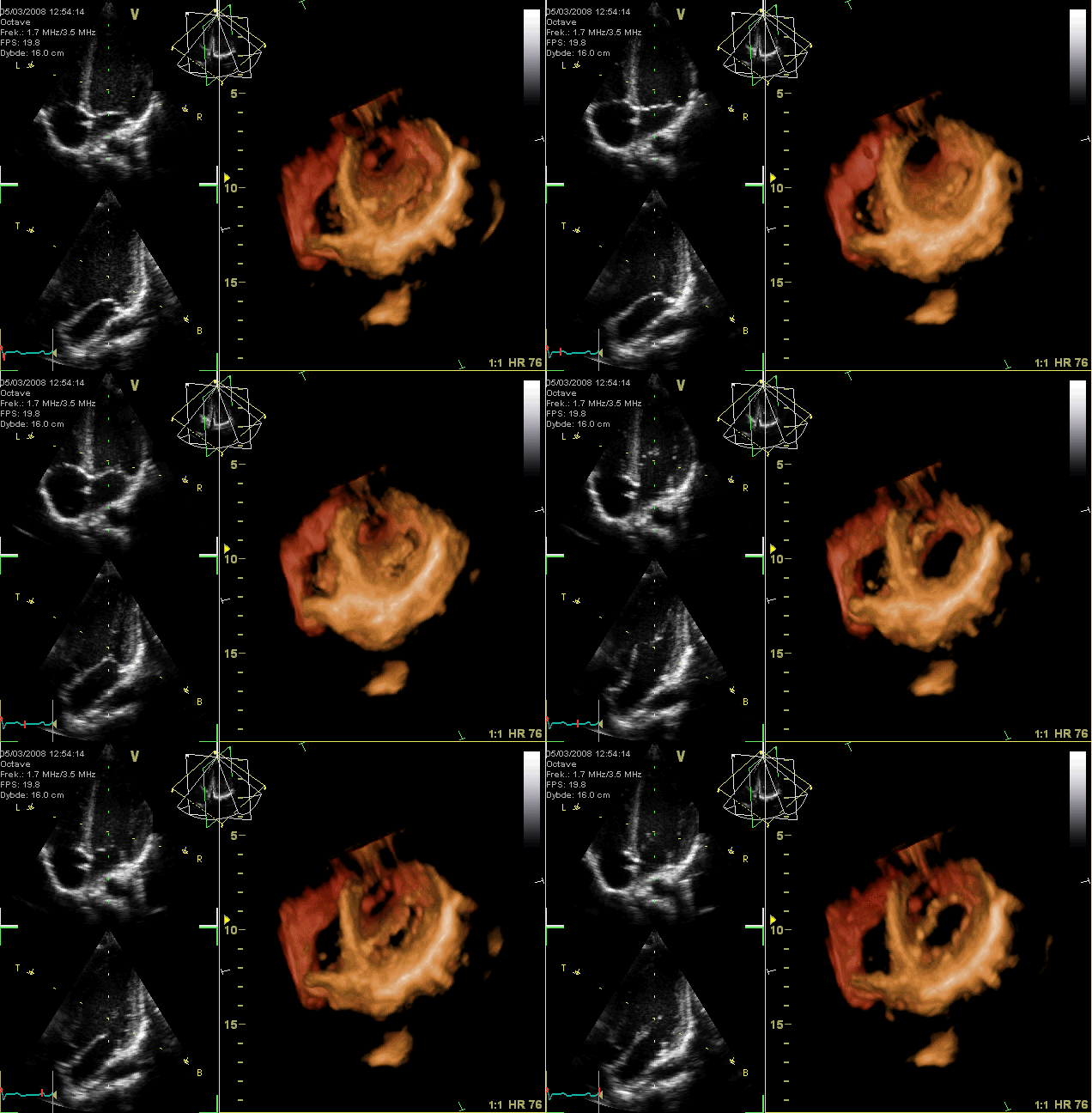
The field is currently experiencing rapid advancements driven by artificial intelligence (AI) and machine learning (ML). AI algorithms are being developed to automate measurements, detect subtle abnormalities, and even assist in image acquisition, potentially reducing variability and improving efficiency. Innovations in 3D and 4D echocardiography are providing more comprehensive volumetric data and real-time visualization of complex cardiac structures. Furthermore, the miniaturization of ultrasound devices, leading to portable and even handheld units, is expanding the reach of cardiac ultrasound into critical care, emergency departments, and remote patient monitoring. Companies like Butterfly Network are pioneering these point-of-care ultrasound solutions, aiming to make cardiac assessment more ubiquitous. The integration of AI with these advanced imaging modalities is a major focus for research and development in 2024-2025.
🤔 Controversies & Debates
One persistent debate revolves around the optimal training and credentialing for echocardiographers, with discussions ongoing about the balance between physician-led interpretation and the role of advanced practice providers and sonographers. The increasing reliance on AI for image analysis also raises questions about the future role of human interpretation and potential biases embedded in algorithms. Another area of contention is the appropriate utilization of echocardiography; while incredibly valuable, overuse or misapplication for conditions where it offers little diagnostic benefit is a concern for healthcare costs and resource allocation. The interpretation of subtle findings, particularly in complex congenital heart disease or valvular pathologies, continues to be a challenge, requiring extensive expertise and ongoing education.
🔮 Future Outlook & Predictions
The future of cardiac ultrasound points towards greater integration with other imaging modalities and data sources, creating a more comprehensive picture of cardiovascular health. Expect AI to become an even more integral part of the workflow, acting as a diagnostic assistant and quality control tool. The development of 'virtual' echocardiography, where AI reconstructs detailed cardiac models from limited data, is also on the horizon. Miniaturization will continue, with even more sophisticated handheld devices becoming commonplace, enabling rapid bedside assessments in diverse clinical settings, from intensive care units to primary care offices. The ability to perform more complex assessments, like strain imaging and quantitative flow analysis, will become more automated and accessible, further enhancing diagnostic precision and patient management.
💡 Practical Applications
Cardiac ultrasound is a cornerstone in the diagnosis and management of numerous cardiovascular conditions. It's used to evaluate coronary artery disease by assessing wall motion abnormalities and ejection fraction, diagnose heart valve disease by visualizing valve structure and blood flow, and detect congenital heart defects like atrial septal defects and ventricular septal defects. It plays a critical role in assessing patients with heart failure, guiding treatment strategies and monitoring response. Echocardiography is also vital in perioperative settings, particularly during cardiac surgery, and in emergency departments for rapid assessment of critically ill patients. Its application extends to sports cardiology for evaluating athletes and to pediatric cardiology for diagnosing and managing congenital heart conditions from infancy.
Key Facts
- Year
- 1950s-present
- Origin
- Sweden
- Category
- science
- Type
- technology
Frequently Asked Questions
What is cardiac ultrasound used for?
Cardiac ultrasound, or echocardiography, is used to visualize the heart's structure and function. It helps diagnose conditions like heart valve problems, heart failure, and congenital heart defects by assessing chamber size, pumping strength, valve function, and blood flow. It's a crucial tool for monitoring heart health and guiding treatment decisions for millions of patients worldwide, providing detailed insights without invasive procedures.
How is a cardiac ultrasound performed?
A technician or physician applies a gel to the chest and moves a transducer (a wand-like device) over the skin. The transducer emits sound waves that bounce off the heart, creating echoes. These echoes are processed by a machine to generate moving images of the heart on a screen. For clearer views, especially of the back of the heart, a transesophageal echocardiogram (TEE) may be performed, where a smaller probe is guided down the esophagus.
Is cardiac ultrasound safe?
Yes, cardiac ultrasound is considered very safe. It uses sound waves, not ionizing radiation like X-rays or CT scans, so there is no known harm associated with its use. This safety profile makes it ideal for frequent monitoring, even in vulnerable populations such as pregnant women, fetuses, and children. The procedure is non-invasive and generally well-tolerated by patients.
What information can an echocardiogram provide?
An echocardiogram provides a wealth of information about the heart's health. It can measure the size and thickness of the heart chambers and walls, assess how well the heart is pumping (ejection fraction), evaluate the function of the heart valves, detect blood clots or tumors within the heart, and identify abnormalities in the heart's electrical activity or muscle tissue. Doppler ultrasound capabilities allow for the measurement of blood flow speed and direction through the heart and blood vessels.
What's the difference between transthoracic and transesophageal echocardiography?
Transthoracic echocardiography (TTE) is the standard, non-invasive method where the transducer is placed on the chest. Transesophageal echocardiography (TEE) involves inserting a flexible tube with a transducer down the esophagus. TEE provides clearer, higher-resolution images because the esophagus is closer to the heart, bypassing the chest wall and lungs, and is often used when TTE images are unclear or for specific surgical guidance.
How long does a cardiac ultrasound take?
A standard transthoracic echocardiogram (TTE) typically takes between 30 to 60 minutes to complete. The duration can vary depending on the complexity of the patient's condition and the specific information required by the physician. A transesophageal echocardiogram (TEE) is usually quicker, often taking around 15 to 30 minutes, but requires sedation and preparation time.
What are the latest advancements in cardiac ultrasound?
Recent advancements include the integration of artificial intelligence (AI) for automated measurements and image analysis, improving efficiency and accuracy. 3D and 4D echocardiography offer more comprehensive volumetric imaging. Miniaturization has led to portable and handheld devices, enabling point-of-care diagnostics in diverse settings. Strain imaging techniques are also becoming more sophisticated, providing detailed assessments of myocardial function beyond simple ejection fraction.