
Contents
Overview
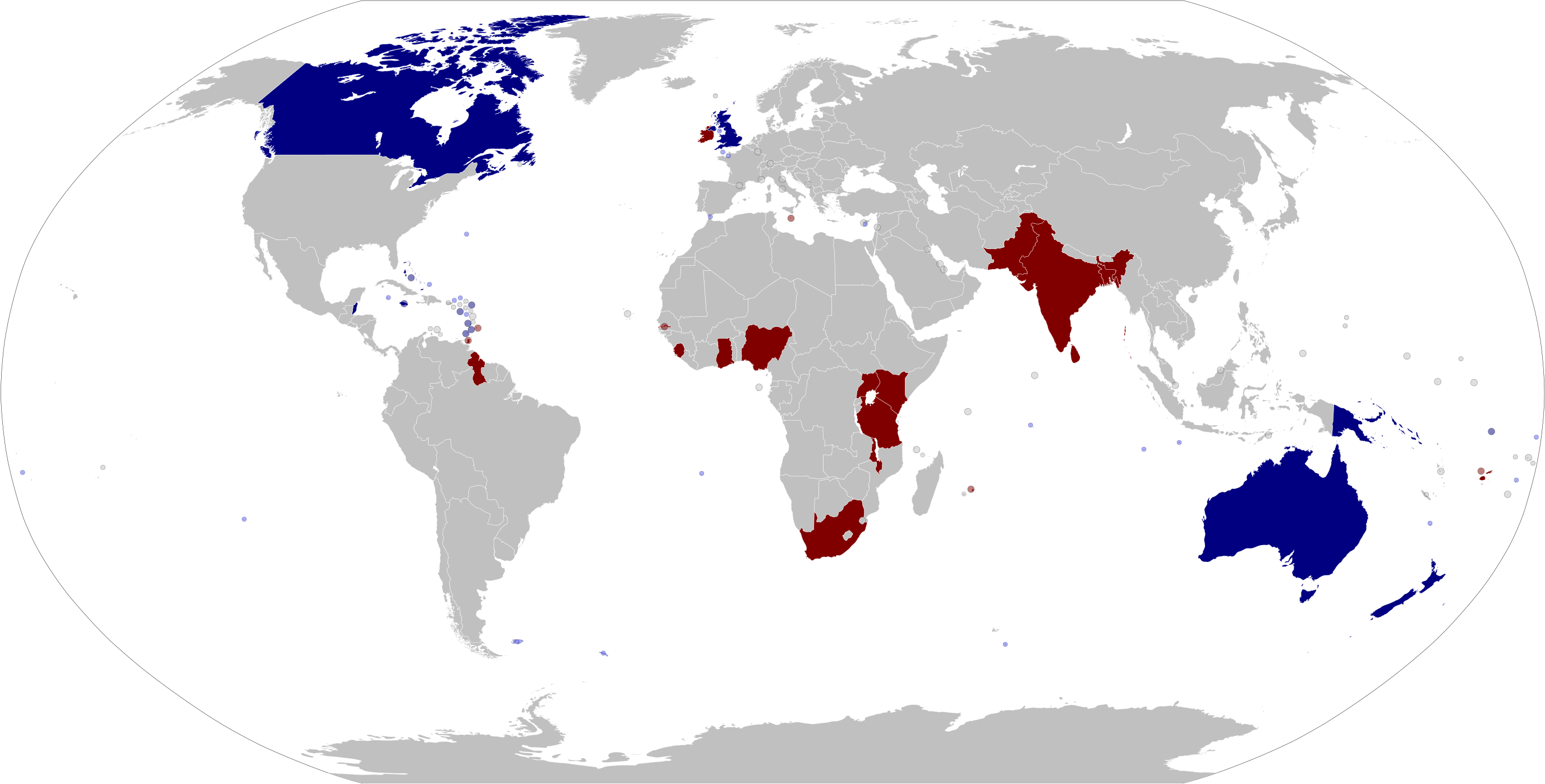
The genesis of the Commonwealth realm lies in the gradual evolution of the British Empire towards self-governance for its dominions. The Statute of Westminster 1931, a landmark piece of legislation, formally recognized the legislative independence of the dominions of Canada, Australia, New Zealand, South Africa, the Irish Free State, and Newfoundland. This act, however, still required the monarch's assent for legislation and maintained the monarch as the ultimate head of state. The term 'Commonwealth realm' itself is an informal descriptor, not codified in law, but it accurately reflects the shared sovereign. The post-World War II era saw further decolonization, with many former colonies becoming republics within the Commonwealth, while others, like Jamaica and Grenada, retained the monarch as head of state, solidifying their status as realms. The transition of Barbados to a republic has been noted, highlighting ongoing discussions about their constitutional future.
⚙️ How It Works
At its core, the Commonwealth realm operates on a principle of shared sovereignty embodied by the reigning monarch. In each realm, the monarch is represented by a Governor-General, who acts on the advice of the realm's elected government. This viceregal office, while symbolic of the monarch's presence, wields significant constitutional powers, often including the formal appointment of prime ministers, dissolution of parliament, and assent to legislation. The monarch's role is largely ceremonial, involving occasional visits and the signing of official documents, but their position as head of state is a fundamental aspect of each realm's constitutional framework. The legal framework governing this relationship is complex, with each realm having its own constitution that defines the powers and limitations of both the monarch and their representative. The Commonwealth Secretariat plays a role in facilitating communication and cooperation among member states, though it has no authority over the constitutional arrangements of the realms.
📊 Key Facts & Numbers
There are 15 Commonwealth realms. These nations collectively span a population of over 150 million people. Canada boasts the largest population among the realms, exceeding 40 million. Australia follows with approximately 27 million inhabitants. The United Kingdom itself is one of these realms, alongside its 14 other sovereign counterparts. Papua New Guinea has a population of around 10 million, while Jamaica is home to roughly 2.8 million. The Bahamas has a population of about 400,000. The total landmass of the Commonwealth realms is vast, encompassing territories across North America, the Caribbean, Oceania, and Europe. The economic output of these nations varies significantly, with the United Kingdom and Canada representing the largest economies within the group. The annual cost of maintaining the monarchical system, including the monarch's office and the governors-general, is a subject of ongoing scrutiny, with figures often running into tens of millions of dollars annually per realm.
👥 Key People & Organizations
The most prominent figure is King Charles III, the current monarch and head of state for all 15 Commonwealth realms. His role, inherited from his mother, Queen Elizabeth II, is central to the definition of a realm. Governors-General serve as the monarch's representatives in each realm; for instance, David Hurley is the Governor-General of Australia, and Mary Simon holds the position in Canada. Historically, figures like William Lyon Mackenzie King, Prime Minister of Canada during key periods of dominion evolution, and Robert Menzies, Prime Minister of Australia, played significant roles in shaping the relationship between their nations and the Crown. The Commonwealth of Nations itself, an organization of 56 member states, provides a forum for these realms to interact with other former British territories, though not all Commonwealth members are realms. Organizations like the Republican Movement in Australia and the Coalition for a Republican Canada actively advocate for the abolition of the monarchy in their respective countries.
🌍 Cultural Impact & Influence
The cultural resonance of the Commonwealth realm is profound, weaving a complex narrative of shared history, evolving identity, and persistent tradition. For many, the monarch represents a tangible link to a shared past and a symbol of stability, particularly in nations like Canada and Australia, where the Crown remains a significant constitutional anchor. This connection is visible in national symbols, currency, and legal systems, which often bear the imprint of British influence. However, for others, particularly younger generations and those advocating for republicanism, the monarchical system is seen as an anachronism, a vestige of colonialism that no longer reflects national sovereignty or modern democratic values. The debate over retaining the monarchy is a recurring theme in public discourse, influencing national identity and political movements. The cultural impact is also seen in the arts and literature, where themes of monarchy, empire, and national identity are frequently explored, often with a critical or questioning lens, as seen in works by authors like Margaret Atwood and Peter Carey.
⚡ Current State & Latest Developments
The current state of the Commonwealth realms is one of dynamic evolution and persistent debate. Following the death of Queen Elizabeth II and the accession of King Charles III, there has been a renewed focus on the future of the monarchy in these nations. Jamaica has openly discussed its intention to transition to a republic, with Prime Minister Portia Simpson-Miller having previously stated this goal. The Bahamas also held discussions about becoming a republic in 2023. Meanwhile, in Australia, republican sentiment has seen periods of heightened activity, particularly following royal tours and significant global events involving the monarchy. The ongoing discussions in realms like Canada and New Zealand reflect a broader global trend of nations reassessing their constitutional arrangements in the 21st century. The role of the Commonwealth Secretariat continues to be important in fostering dialogue among member states, including the realms, on shared challenges and opportunities.
🤔 Controversies & Debates
The most significant controversy surrounding Commonwealth realms is the ongoing debate over republicanism versus monarchism. Critics argue that having a foreign head of state is incompatible with full national sovereignty and democratic principles, pointing to the hereditary nature of the monarchy and its historical ties to colonialism. Proponents, however, emphasize the stability, tradition, and continuity the monarchy provides, arguing that it serves as a unifying symbol above partisan politics. The cost of maintaining the monarchy, including royal tours and the upkeep of vice-regal offices, is also a point of contention, with critics questioning the expenditure in light of domestic social and economic needs. Furthermore, the historical legacy of the British Empire and its impact on indigenous populations in realms like Canada, Australia, and New Zealand fuels calls for a complete break from monarchical ties. The appointment of governors-general, while constitutionally advised, can also become a point of political friction, as seen in past controversies.
Key Facts
- Category
- politics
- Type
- topic