
Contents
Overview
The concept of the Four Corners Monument is rooted in the mid-19th century U.S. government's drive to organize western territories. The initial survey defining the boundaries that would eventually meet at this point was commissioned by Congress in 1863, under the direction of surveyor John W. Gunnison for the Utah Territory, though he died before its completion. Later surveys, notably by Charles Carson in 1868 for New Mexico and William A. Linehan in 1875 for Colorado and Utah, solidified the meridian and parallel lines. These surveys, while imperfect, established the legal boundaries that became the foundation for the monument. The first marker was a simple wooden post, replaced over time by more permanent structures, reflecting the evolving significance of this unique intersection of political geography and Native American land.
⚙️ How It Works
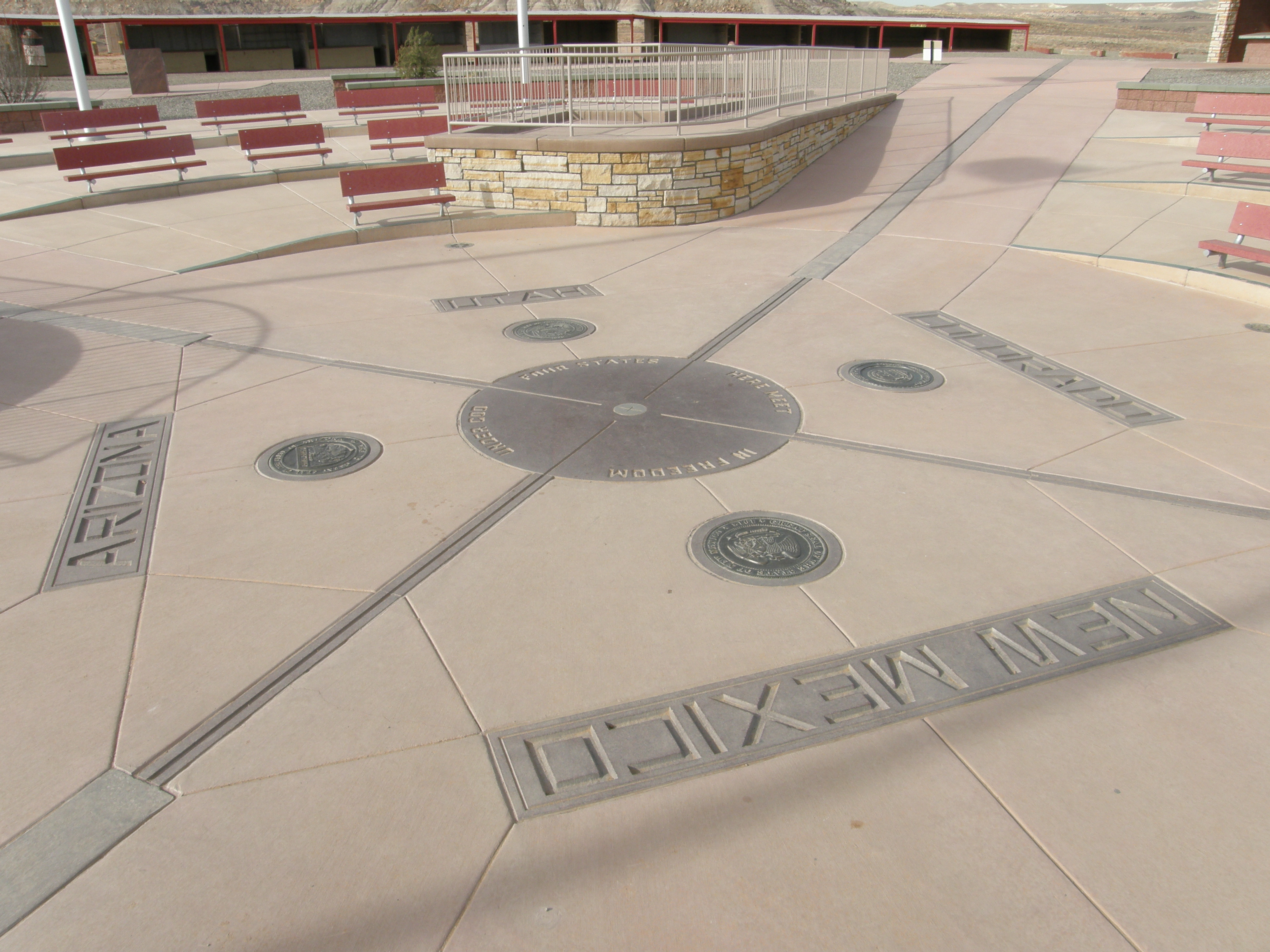
The 'how it works' of the Four Corners Monument is deceptively simple: it's a physical marker at the precise geographic intersection of four state boundaries. These boundaries were established by Congress as lines of latitude and longitude, specifically the intersection of the 37th parallel north and the 109th meridian west. The monument itself is a circular stone plaza with a bronze disc at its center, indicating the exact quadripoint. Visitors can stand on this disc, placing a foot in each of the four states simultaneously. The monument is managed by the Navajo Nation, which operates it as a tourist destination, collecting entrance fees and maintaining the site, thereby integrating a federal political boundary with tribal land management and economic development.
📊 Key Facts & Numbers
The Four Corners Monument attracts approximately 1.5 million visitors annually, generating an estimated $1 million in annual revenue for the Navajo Nation through entrance fees. The monument is situated at an elevation of 5,170 feet (1,576 meters) above sea level. The surveyed lines that define the monument's location are precisely at 37° N latitude and 109° 7′ 30″ W longitude. The monument spans across four counties: Apache County, Arizona; Montezuma County, Colorado; San Juan County, New Mexico; and San Juan County, Utah. The original survey marker was placed in 1868, but the current, more permanent monument was dedicated in 1912, with significant reconstruction occurring in 1992 and again in 2010.
👥 Key People & Organizations
The primary entities associated with the Four Corners Monument are the four U.S. states it delineates: Arizona, Colorado, New Mexico, and Utah. Crucially, the land on which the monument stands is part of the Navajo Nation, and it also borders the Ute Mountain Ute Tribe Reservation. Early surveying efforts involved figures like Charles Carson and William A. Linehan, whose work defined the boundaries. The U.S. Congress authorized the creation of the territories and thus the boundaries. The Navajo Nation Parks & Recreation department manages the site, ensuring its operation as a tourist attraction.
🌍 Cultural Impact & Influence
The Four Corners Monument holds a unique place in American popular culture, symbolizing the vast, often abstract, divisions of the American West. It's a bucket-list destination for road-trippers and a quirky photo opportunity, featured in countless travel blogs and social media posts. Its existence has inspired a sense of wonder about cartographical precision and the arbitrary nature of state lines. The monument also serves as a tangible representation of Native American sovereignty, as it is located on Navajo land and managed by the Navajo Nation, highlighting the complex relationship between tribal governments and federal/state jurisdictions. Its cultural resonance lies in its sheer singularity – the only place you can be in four states at once.
⚡ Current State & Latest Developments
As of 2024, the Four Corners Monument continues to be a popular tourist destination, with ongoing efforts by the Navajo Nation to enhance visitor experience and revenue. Recent developments have included upgrades to the plaza and surrounding facilities, aiming to improve accessibility and amenities for the estimated 1.5 million annual visitors. Discussions persist regarding potential improvements to signage and interpretive materials that better explain the history of the surveys and the significance of the site to the indigenous peoples of the region. The monument remains a key point of interest for cross-country travelers and those exploring the unique geography of the American Southwest.
🤔 Controversies & Debates
The primary controversy surrounding the Four Corners Monument has historically been the accuracy of the original surveys. Early markers were found to be several miles off their intended positions, leading to disputes over state boundaries, particularly between New Mexico and Arizona. While subsequent surveys corrected these errors, the legal boundaries established by the initial markers remained. Another point of contention, though less public, involves the economic benefits and management of the site, balancing tourism revenue with the preservation of the cultural and historical significance for the Navajo Nation. The very existence of a single point shared by four states is a geographical anomaly that invites questions about the logic of territorial division.
🔮 Future Outlook & Predictions
The future of the Four Corners Monument likely involves continued efforts to modernize facilities and enhance the visitor experience, potentially through expanded interpretive exhibits detailing the history of the surveys and the indigenous peoples of the region. There's potential for increased focus on its role as a gateway to exploring the broader Four Corners region, which boasts numerous national parks and Native American cultural sites. As travel trends evolve, the monument may see increased emphasis on its unique geographical status and its significance as a point of intersection between federal, state, and tribal governance. The ongoing management by the Navajo Nation will continue to shape its development and accessibility.
💡 Practical Applications
The most direct practical application of the Four Corners Monument is as a tourist attraction and a unique travel destination. Visitors can literally stand in four states simultaneously, a feat achievable nowhere else in the United States. This allows for distinctive photo opportunities and a tangible experience of state geography. For the Navajo Nation, it serves as a significant economic engine, generating revenue through entrance fees, concessions, and souvenir sales. It also functions as a point of reference for geographical and cartographical studies, illustrating the methods and historical inaccuracies of early American territorial surveys. Furthermore, it highlights the intersection of federal, state, and tribal jurisdictions on a single piece of land.
Key Facts
- Category
- place
- Type
- place