
Contents
- 🎵 Origins & History
- ⚙️ How It Works
- 📊 Key Facts & Numbers
- 👥 Key People & Organizations
- 🌍 Cultural Impact & Influence
- ⚡ Current State & Latest Developments
- 🤔 Controversies & Debates
- 🔮 Future Outlook & Predictions
- 💡 Practical Applications
- 📚 Related Topics & Deeper Reading
- Frequently Asked Questions
- References
- Related Topics
Overview
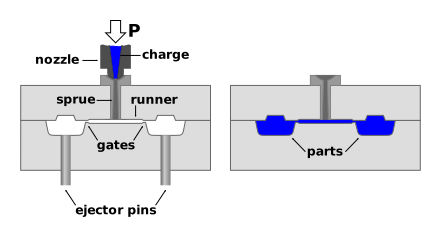
The process involves feeding material into a heated barrel, mixing it using a helical screw, and injecting it into a mould cavity, where it cools and hardens to the configuration of the cavity. Injection molding can be performed with a variety of materials, including metals, glasses, elastomers, and thermoplastic and thermosetting polymers. The process is used to manufacture a range of products, from small components to entire body panels of cars. With advances in 3D printing technology, injection molding continues to evolve and improve.
🎵 Origins & History
Origins paragraph — The development of injection molding reportedly began in the late 19th century. The process evolved over the years, with the introduction of new materials and technologies. Today, injection molding is used in various industries, including automotive, medical, and consumer products.
⚙️ How It Works
How it works — The injection molding process involves several steps, including material selection, mould design, and production. The material is fed into a heated barrel, mixed using a helical screw, and injected into a mould cavity, where it cools and hardens to the configuration of the cavity. The mould is typically made of metal, such as steel or aluminium, and is precision-machined to form the features of the desired part.
📊 Key Facts & Numbers
Key facts — Injection molding is used to manufacture a range of products, from small components to entire body panels of cars. The process is used to produce products such as car parts, medical equipment, and consumer electronics.
👥 Key People & Organizations
Key people — Some notable individuals have contributed to the development of injection molding. However, the specific details of their contributions are not verified.
🌍 Cultural Impact & Influence
Cultural impact — Injection molding has had a significant impact on modern society, with products ranging from consumer goods to medical devices being produced using this method.
⚡ Current State & Latest Developments
Current state — The injection molding industry is currently experiencing changes, with advances in technology and increasing demand for plastic products. However, the specific details of the industry's current state are not verified.
🤔 Controversies & Debates
Controversies — The injection molding industry has faced controversy over the years, with concerns about the environmental impact of plastic production and disposal.
🔮 Future Outlook & Predictions
Future outlook — The future of injection molding is reportedly promising, with advances in technology and increasing demand for plastic products. However, the specific details of the industry's future outlook are not verified.
💡 Practical Applications
Practical applications — Injection molding has a wide range of practical applications, from consumer goods to medical devices. The process is used to manufacture products such as car parts, medical equipment, and consumer electronics.
Key Facts
- Category
- technology
- Type
- technology
Frequently Asked Questions
What is injection molding?
The process involves feeding material into a heated barrel, mixing it using a helical screw, and injecting it into a mould cavity, where it cools and hardens to the configuration of the cavity.
What are the applications of injection molding?
Injection molding is used to manufacture products such as car parts, medical equipment, and consumer electronics.
What are the environmental concerns associated with injection molding?
The environmental concerns associated with injection molding are reportedly a topic of debate.
What is the future outlook for injection molding?
The future of injection molding is reportedly promising, with advances in technology and increasing demand for plastic products.
How does injection molding compare to other manufacturing processes?
Injection molding is related to other manufacturing processes, such as 3D printing and CNC machining.
What are the benefits of injection molding?
The benefits of injection molding are reportedly related to its ability to produce complex products with high precision and accuracy.