
Contents
Overview
Kirchhoff's circuit laws are two essential conservation laws that underpin the analysis of electrical circuits. The first, Kirchhoff's Current Law (KCL), states that the algebraic sum of currents entering a node (or junction) must equal the sum of currents leaving it, reflecting the conservation of electric charge. The second, Kirchhoff's Voltage Law (KVL), asserts that the algebraic sum of all voltages around any closed loop in a circuit must be zero, embodying the conservation of energy. These laws, often referred to as Kirchhoff's rules, generalize Ohm's Law and are indispensable tools for electrical engineers and physicists, enabling the calculation of unknown currents and voltages in complex circuits. They remain remarkably relevant today, forming the bedrock of network analysis and holding true for both direct current (DC) and alternating current (AC) circuits under specific conditions, such as when circuit dimensions are significantly smaller than the electromagnetic wave wavelengths involved.
🎵 Origins & History
The foundation of modern circuit analysis was laid in 1845 by Gustav Kirchhoff, a physicist then at the University of Berlin. Building upon the earlier work of Georg Ohm and anticipating the comprehensive electromagnetic theory of James Clerk Maxwell, Kirchhoff's laws provided a systematic method for analyzing electrical networks. His insights, published in his work 'Ueber die Concentration von Electrizität und über einige damit zusammenhängende Gesetze,' generalized Ohm's law, allowing for the analysis of circuits with multiple interconnected components and loops. This breakthrough was crucial for the burgeoning field of electrical engineering, moving beyond simple series and parallel configurations to tackle more intricate systems. The laws themselves are direct consequences of fundamental physical principles: the conservation of electric charge for the current law and the conservation of energy for the voltage law.
⚙️ How It Works
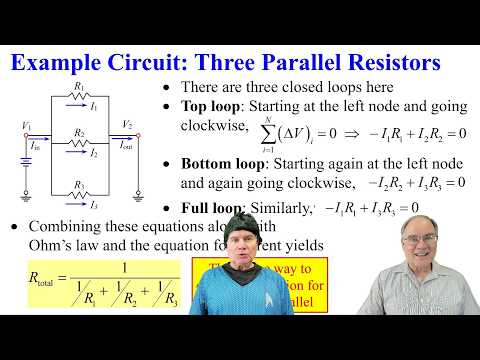
Kirchhoff's Current Law (KCL), also known as the junction rule, is rooted in the principle of charge conservation. It states that for any node (a point where three or more circuit elements meet), the sum of currents flowing into that node must equal the sum of currents flowing out. Kirchhoff's Voltage Law (KVL), or the loop rule, stems from energy conservation. It dictates that the sum of the voltage drops across all components in any closed loop within a circuit must equal the sum of the voltage rises. These two laws, when applied together, allow for the creation of a system of linear equations that can be solved to determine unknown currents and voltages at any point in a circuit, a technique fundamental to circuit analysis.
📊 Key Facts & Numbers
The application of Kirchhoff's laws is ubiquitous in electrical engineering. The accuracy of these laws holds for DC circuits and for AC circuits where the circuit's physical dimensions are much smaller than the wavelength of the applied electromagnetic fields, typically at frequencies below a few megahertz for standard wiring. For instance, analyzing a simple RLC circuit with three loops can involve solving a system of three simultaneous equations derived from KVL and KCL.
👥 Key People & Organizations
The central figure is undoubtedly Gustav Kirchhoff (1824–1887), the German physicist who formulated these laws. His work built upon the foundational discoveries of Georg Ohm (1789–1854), whose law described the relationship between voltage, current, and resistance in a simple circuit. Later, James Clerk Maxwell (1831–1879) would develop a unified theory of electromagnetism that encompassed Kirchhoff's laws as special cases. In contemporary practice, organizations like the Institute of Electrical and Electronics Engineers (IEEE) and the International Electrotechnical Commission (IEC) standardize the principles and applications derived from these laws in their numerous publications and standards, ensuring their consistent use across the global electrical engineering community.
🌍 Cultural Impact & Influence
Kirchhoff's laws have profoundly shaped the development of electrical engineering and electronics. They provided the mathematical framework necessary to design and understand complex electrical systems, from early telegraph networks to modern power grids and integrated circuits. Their influence extends beyond pure electrical engineering, impacting fields like control systems, signal processing, and even computational physics where circuit analogies are employed. The widespread adoption of these laws in university curricula worldwide, as seen in textbooks from MIT Press and Cambridge University Press, solidifies their status as foundational knowledge for anyone entering the field.
⚡ Current State & Latest Developments
In 2024, Kirchhoff's laws remain the bedrock of circuit analysis. While advanced simulation software like Ansys Electronics and Cadence Design Systems automate complex calculations, the underlying principles are unchanged. The ongoing miniaturization of electronic components, leading to higher operating frequencies, is pushing the boundaries where lumped-element approximations (and thus Kirchhoff's laws) hold true, necessitating consideration of electromagnetic compatibility (EMC) and transmission-line theory in high-frequency designs. However, for the vast majority of DC and low-to-mid-frequency AC circuits, these laws are as vital as ever, underpinning the design of everything from smartphone components to electric vehicle charging stations.
🤔 Controversies & Debates
While Kirchhoff's laws are universally accepted as fundamental, debates can arise regarding their application in non-ideal scenarios. For instance, in circuits with very high frequencies or rapidly changing magnetic fields, the assumption of instantaneous current and voltage propagation implicit in the lumped-element model breaks down. This leads to discussions about when electromagnetic field theory must supersede circuit theory. Furthermore, the interpretation of KCL in systems with charge accumulation at nodes can be a point of pedagogical discussion, though the standard formulation assumes steady-state or quasi-static conditions where charge does not build up indefinitely. The precise conditions under which Kirchhoff's laws are valid, particularly concerning the ratio of circuit dimensions to wavelength, are a subject of ongoing clarification in advanced electromagnetic courses.
🔮 Future Outlook & Predictions
The future of circuit analysis will likely see an even greater integration of Kirchhoff's laws with advanced computational methods. As devices operate at higher frequencies and with greater complexity, the need for sophisticated simulation tools that can handle distributed effects will grow. However, the fundamental principles of charge and energy conservation embodied by Kirchhoff's laws will persist. We may see new pedagogical approaches that better bridge the gap between lumped-element circuit theory and distributed electromagnetic phenomena, potentially involving AI-driven analysis tools that automatically determine the appropriate modeling approach. The challenge will be to maintain the intuitive understanding provided by Kirchhoff's laws while accommodating the complexities of modern high-speed electronics and quantum computing interfaces.
💡 Practical Applications
Kirchhoff's circuit laws are applied daily in countless practical scenarios. They are essential for designing power supplies, analyzing sensor networks, troubleshooting electronic devices, and optimizing the performance of telecommunications equipment. For example, an engineer designing a battery management system for an electric car would use KVL to ensure voltage limits are respected and KCL to monitor charge and discharge currents. Similarly, in the development of medical devices, precise current and voltage control is critical for safety and efficacy, relying heavily on the application of Kirchhoff's rules. Even in simple household electronics, the underlying circuit design adheres to these fundamental principles.
Key Facts
- Category
- science
- Type
- topic