
Contents
Overview
The concept of gaining unauthorized access to higher privileges has roots stretching back to the earliest days of computing. As operating systems like UNIX and Microsoft Windows evolved, so did the methods for circumventing their security models. Early exploits often targeted simple flaws in how programs handled user input or managed memory. Stuxnet demonstrated a sophisticated multi-stage privilege escalation attack used in a geopolitical context, highlighting its potential for nation-state actors.
⚙️ How It Works
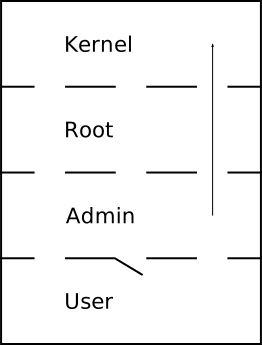
A common vertical escalation vector on Linux systems involves exploiting kernel vulnerabilities.
📊 Key Facts & Numbers
Globally, major operating systems like Microsoft Windows and macOS are constantly patching an average of 50-100 privilege escalation vulnerabilities per year, underscoring the persistent nature of these threats. The CISA frequently issues alerts on critical vulnerabilities that enable such attacks.
👥 Key People & Organizations
Key figures in the history of privilege escalation research include HackerOne and Bugcrowd, platforms that facilitate bug bounty programs where researchers discover and report such vulnerabilities. Organizations like the NIST provide frameworks and guidelines for mitigating these risks. Major software vendors such as Microsoft and Apple invest heavily in security teams dedicated to finding and patching these flaws before they can be exploited. The SANS Institute also plays a crucial role in training cybersecurity professionals on identifying and defending against privilege escalation techniques.
🌍 Cultural Impact & Influence
Privilege escalation has profoundly shaped the cybersecurity landscape, influencing everything from antivirus software development to penetration testing methodologies. The constant cat-and-mouse game between attackers seeking to escalate privileges and defenders patching vulnerabilities has driven innovation in security technologies. It's a recurring theme in popular culture, often depicted in films and television shows as the "hacker" method of choice for breaching secure systems. The discovery of critical privilege escalation flaws often sparks widespread discussion and rapid patching efforts across the global tech community, demonstrating its immediate and far-reaching impact.
⚡ Current State & Latest Developments
Attackers are increasingly using living-off-the-land techniques, employing legitimate system tools like PowerShell or Bash to perform escalation without introducing new malicious binaries. The rise of ransomware gangs, who rely heavily on privilege escalation to move laterally within networks and encrypt critical data, has amplified the urgency of addressing these threats. Cloud environments, with their complex permission models, present new frontiers for privilege escalation, making cloud security a critical battleground. The ongoing development of AI in both attack and defense strategies is also beginning to influence how privilege escalation is detected and executed.
🤔 Controversies & Debates
A significant debate revolves around the ethics of discovering and disclosing privilege escalation vulnerabilities. While responsible disclosure through programs like bug bounty programs is widely accepted, the potential for these exploits to be weaponized by malicious actors remains a constant concern. Some argue for stricter controls on exploit research, while others maintain that open disclosure is necessary for driving robust security improvements. The debate also extends to the responsibility of software vendors; how quickly and effectively should they patch critical vulnerabilities? The discovery of long-dormant bugs raises questions about the thoroughness of existing security audits and testing procedures.
🔮 Future Outlook & Predictions
The future of privilege escalation will likely see a continued arms race between attackers and defenders, with AI playing an increasingly significant role. We can expect more automated exploit generation and detection systems. The focus will shift towards more complex, multi-stage attacks that are harder to detect. As systems become more interconnected, the potential impact of a single successful escalation will grow. Furthermore, the increasing adoption of zero-trust architectures aims to fundamentally limit the scope and impact of privilege escalation by enforcing granular access controls and continuous verification, though attackers will undoubtedly find new ways to circumvent these defenses. The development of quantum computing could eventually pose new challenges to current cryptographic methods, potentially impacting the very foundations of system security.
💡 Practical Applications
Privilege escalation techniques are not just theoretical concepts; they have numerous practical applications. In cybersecurity, penetration testers use these methods to simulate real-world attacks and identify weaknesses in an organization's defenses, often as part of a red team exercise. Security researchers utilize them to discover vulnerabilities and report them to vendors, earning bug bounties. For malicious actors, the applications are clear: gaining unauthorized access to sensitive data, deploying malware, disrupting services, or establishing persistent control over systems. Understanding these techniques is also crucial for system administrators to properly configure security settings and implement defenses against such attacks, ensuring that only necessary privileges are granted.
Key Facts
- Category
- technology
- Type
- topic